Events Archive

RHS Lecture: ‘The Haunting at the Rectory: Ghost Stories and Women’s Lives in Early Modern England’

In this event Professor Sasha Handley (University of Manchester) presented her lecture on ‘The Haunting at the Rectory: Ghost Stories and Women’s Lives in Early Modern England’.

The lecture took place on Friday 1 May 2026 and was hosted by the Royal Historical Society. Sasha’s lecture took place as part of the Society’s day visit to the University of Warwick.


  • Watch the lecture

  • Listen to a recording of this lecture


About this lecture

In the winter of 1716-17, a ghost tormented the residents of Epworth Rectory in Lincolnshire for four long months. The rectory was the home of the Wesley family, a home that would become feted as the cradle of evangelical Methodism by the end of the eighteenth century.

Reports of the rectory haunting, however, tell a very different story of this illustrious family residence. They reveal it as a place of longstanding family divisions, of deprivation and trauma, but also of resilience and strategic protest. This paper uncovers this alternative family history, whilst also reflecting on the role that ghost stories could play in the lives of early modern women more broadly. Finally, the talk examines the long-term legacies of women’s ghostly storytelling.

About our speaker

Sasha Handley is Professor of Early Modern History at the University of Manchester. She is the author of monographs Visions of an Unseen World: Ghost Beliefs and Ghost Stories in Eighteenth-Century England (2007), Sleep in Early Modern England (2016), and co-editor of New Directions in Social and Cultural History (2018).

Sasha has co-curated two exhibitions: Magic, Witches & Devils in the Early Modern World (2016, John Rylands Research Institute and Library), and Albrecht Dürer’s Material World (2023-24, The Whitworth). She currently leads the Wellcome Trust Investigator Award ‘Sleeping Well in the Early Modern World: An Environmental Approach to the History of Sleep Care’.


RHS Lecture: ‘Alike in Appearance but not in Scope’: Queens and the Making of Medieval Europe

In this event Professor Charles West (University of Edinburgh) presented his lecture on ‘Alike in Appearance but not in Scope’: Queens and the Making of Medieval Europe.

The lecture took place on Friday 6 February 2026 and was hosted by the Royal Historical Society, UK.


  • Listen to a recording of this lecture


  • Watch the Lecture


About this lecture

Whereas medieval kings tended to rule in the same place they were born, queens were routinely foreigners within their own realm. This lecture starts from this simple observation to reconsider the position of queens in the ‘making’ of post-Carolingian Europe, alongside that of the knights and clerics on whom historical attention has often focused.

Through a set of case studies, the lecture looks at the role played by queens as cultural ambassadors in creating, both deliberately and unwittingly, a human network that transcended political borders.

About our speaker

Professor Charles West is Professor of Medieval History History at the University of Edinburgh with research interests in the history of Europe in the early and high Middle Ages. Charles’s research focuses on changes in ideas and practices of public order with reference to three principal areas: the relationship between religious and secular fields of activity, local society and its relation to hegemonic authority, and comparisons of regional, regnal, European and Eurasian scales of analysis.

Charles is the author of nine monographs, co-authored books and edited collections. Of these the most recent are: Europe in the Eleventh Century. Beyond Revolution and Reform (OUP, 2025), Local Priests in the Latin West, 900–1050, co-written with Alice Hicklin, Steffen Patzold and Bastiaan Waagmeester (CUP, 2025) and The Fall of a Carolingian Kingdom – University of Toronto Press (University of Toronto Press, 2023). Prior to moving to Edinburgh in 2023, Charles taught for 15 years at the University of Sheffield.


RHS Anniversary Lecture: ‘Visible | Invisible: Voices of Women in Early Modern Ireland’

In this event Professor Jane Ohlmeyer (Trinity College Dublin) presented her lecture on ‘Visible | Invisible: Voices of Women in Early Modern Ireland’.

The lecture, which was the Society’s 2025 Anniversary Lecture, took place on Friday 21 November 2025 and was hosted by the Royal Historical Society, UK.


  • Listen to a recording of this lecture


  • Watch the Lecture

About this lecture

This lecture draws on findings from VOICES, an Advanced European Research Council grant (2023-28) that documents the lived experiences of non-elite women in Ireland between 1550 and 1700 and who have largely been ignored by scholars more interested in privileging the stories of men of power and influence.

These women lived in patriarchal societies where they were regarded as being subordinate to men in the domestic and public spheres. This patriarchy and misogyny are baked into most of the extant records, which helps to explain the invisibility of these women, along with the more general scarcity of historical sources recording their lives.

How can technologies, especially those associated with Artificial Intelligence and the Knowledge Graph, render visible the invisible and help to recover the lived experiences women in historical records? How can this be done at scale and ethically? How can we ensure that methodologies and processes developed as part of VOICES cross time and place and are replicable in other regions and time periods?

About our speaker

Professor Jane Ohlmeyer MRIA, FBA, FTCD, FRHistS, is Erasmus Smith’s Professor of Modern History (1762) at Trinity College Dublin. She was a driving force behind the 1641 Depositions Project and the development of the Trinity Long Room Hub Arts and Humanities Research Institute. Jane chaired the Irish Research Council (2015-21). In 2023, she received an Advanced ERC for VOICES, a project on the lived experiences of women in early modern Ireland.

Jane is the author or editor of numerous articles and 14 books. Her latest, Making Empire: Ireland, Imperialism and the Early Modern World (Oxford, 2023), is based on the 2021 Ford Lectures in Oxford. In 2023 she was awarded the Royal Irish Academy Gold Medal in the Humanities. She is currently working with Briona Ni Dhiarmada on a booked called From that Small Island. The Story of the Irish which is based on a 4-part documentary and a feature.


RHS Public History Lecture — ‘Minor Criminal: The Trial of the Man Who Murdered My Grandmother’

‘Minor Criminal: The Trial of the Man Who Murdered My Grandmother’, with Daniel Finkelstein

Royal Historical Society 2025 Public History Lecture
on 4 November 2025


Abstract

In April 1945, British forces liberated the Bergen-Belsen concentration camp and arrested its commandant, Josef Kramer. What followed was the first post-war trial for war crimes – a landmark event that captured the world’s attention. Although later eclipsed by the Nuremberg Trials, the Belsen Trial marked a pivotal moment in confronting Nazi atrocities and establishing a framework for justice after the Holocaust.

For Lord Daniel Finkelstein, the story of Belsen is deeply personal. Among those imprisoned and starved in the camp were his mother and grandmother – his grandmother did not survive. In this lecture, Lord Finkelstein will recount the story of the Belsen Trial, exploring how it brought the horrors of the concentration camps to light and how it continues to shape his understanding of law, justice, and moral responsibility.

  • Watch the Lecture


RHS Lecture: ‘Mars and Britannia: the British Imperial Way of Warfare’

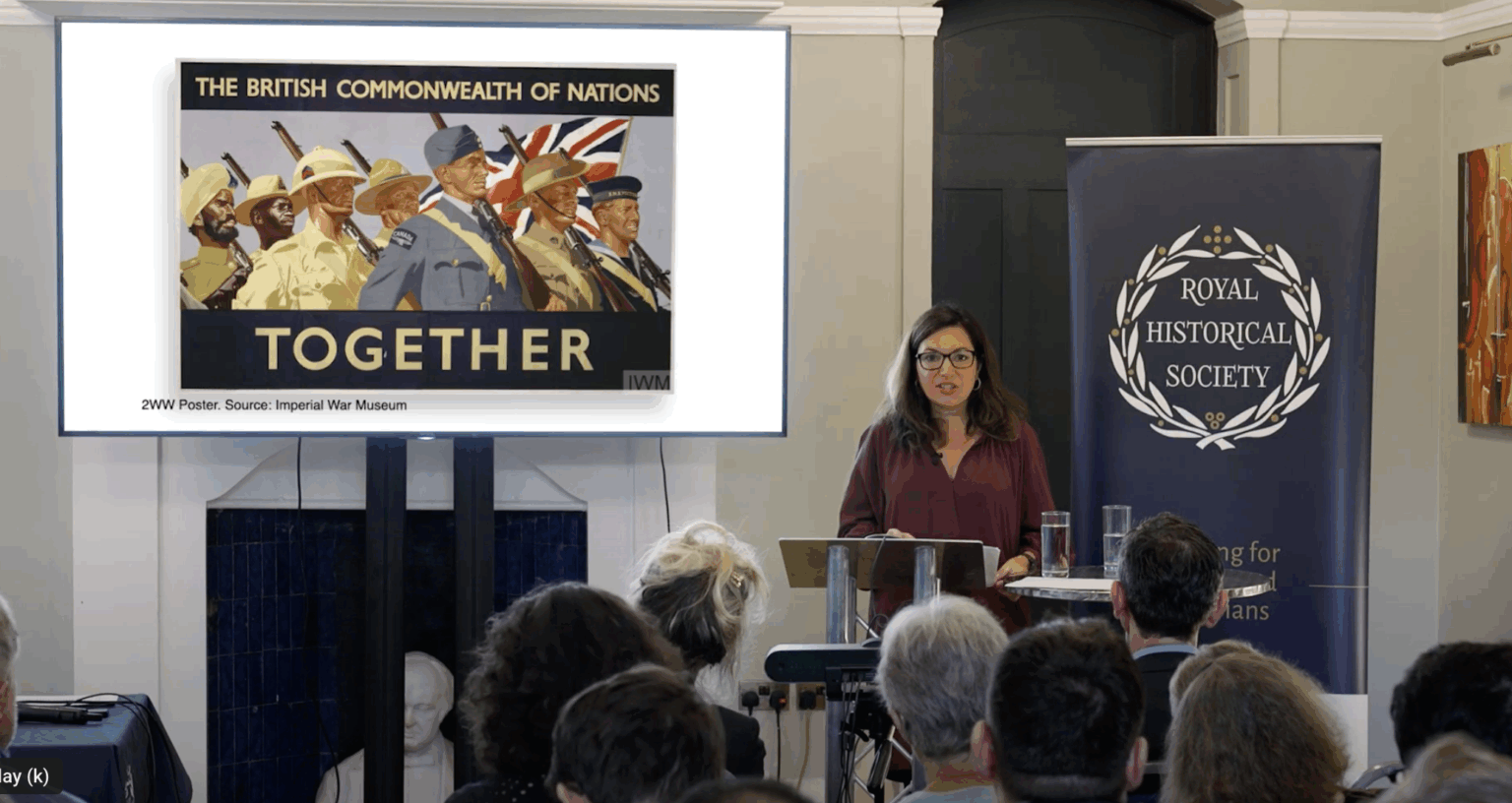
In this event Professor Yasmin Khan (University of Oxford) presented his lecture on ‘Mars and Britannia: the British Imperial Way of Warfare’. The lecture took place on Friday 12 September 2025 and was hosted by the Royal Historical Society, UK.

Watch the lecture


Listen to the audio version of this lecture


About this lecture

British military power around the world was dependent on non-European people for two hundred years. This lecture will demonstrate just how extensively British military history has relied on non-British people over continents and centuries.

This is a global story, rich in characters and untold stories, and covers locations from the deserts of North Africa to the islands of the Pacific and jungles of East Asia. It has the potential to revise understandings of our national history in profound ways.

About our speaker

Yasmin Khan is Professor of Modern History at the University of Oxford where she teaches Global and Imperial history. She was born in London, educated at Oxford, and has taught at the Universities of Edinburgh and London. She is the author of The Great Partition: The Making of India and Pakistan (Yale, 2007) and The Raj at War (Bodley Head, 2015).

Yasmin has been long-listed for prizes including the Orwell Prize, the Authors’ Club of Great Britain First Novel Prize, the PEN Hesell-Tiltman, and has won the Gladstone Prize for history and a Royal Television society award. She is an editor of History Workshop Journal. She has worked with part-time students at Oxford since 2012 and has a particular interest in working with lifelong learners.


RHS Prothero Lecture: ‘Refugee World(s): a Twentieth-Century Retrospective’

In this event Peter Gatrell FBA (Emeritus Professor of History, University of Manchester) presented his lecture on ‘Refugee World(s): a Twentieth-Century Retrospective’. The lecture took place on Wednesday 2 July 2025 and was hosted by the Royal Historical Society, UK.

Watch the lecture


Listen to the audio version of this lecture


About the 2025 Prothero Lecture

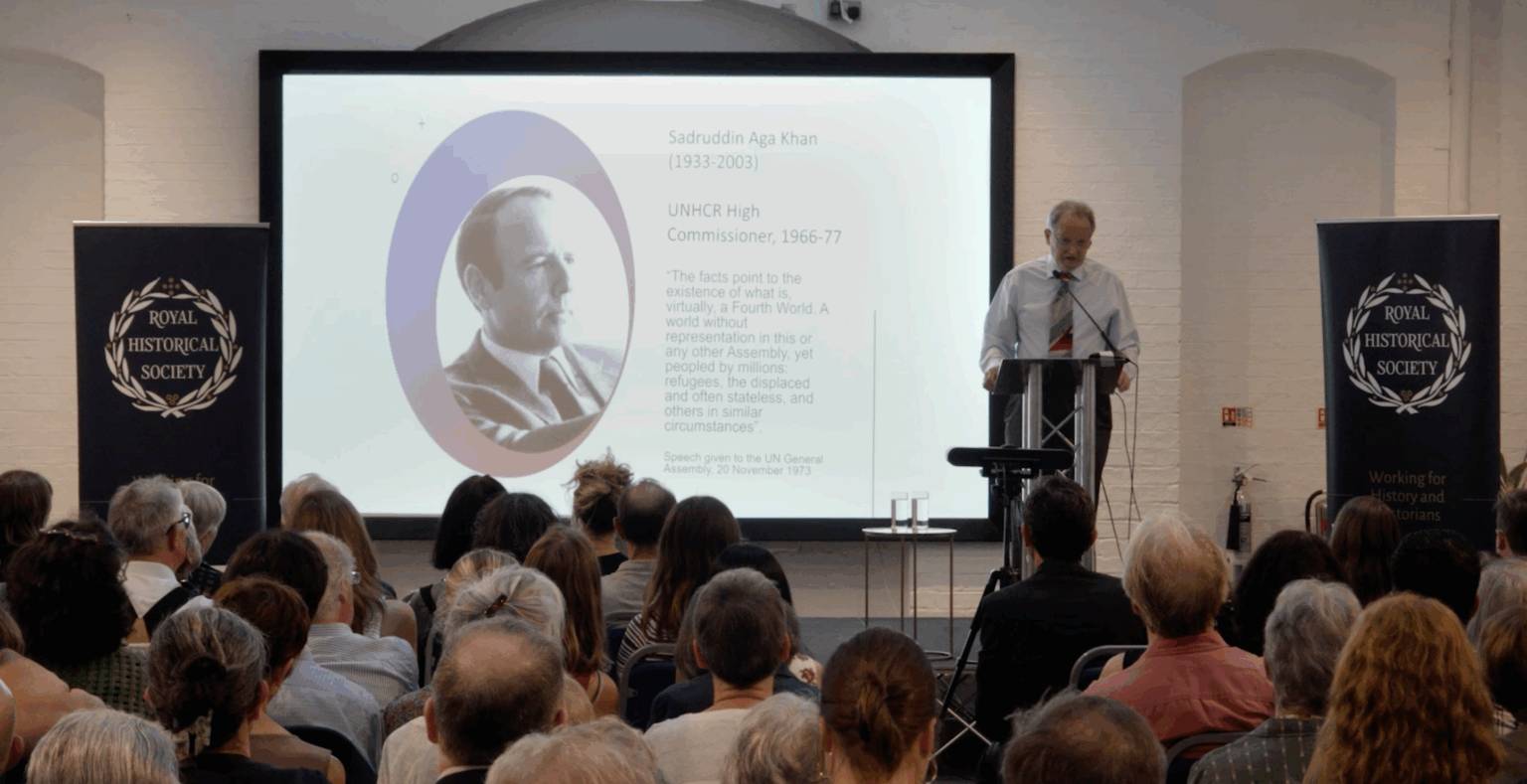
In 1973 Prince Sadruddin Aga Khan, the high commissioner of UNHCR, the UN Office for Refugees, declared to the UN General Assembly: ‘The facts point to the existence of what is, virtually, a Fourth World. A world without representation in this or any other Assembly, yet peopled by millions: refugees, the displaced and often stateless, and others in similar circumstances’.

In this lecture Peter Gatrell will suggest that we can write refugees into modern global history only by taking account of other worlds as well. It may be legitimate to think of the ‘refugee world’ as a distinct realm of being but it is more appropriate to consider refugees’ encounters with refugee-creating and refugee-hosting (and refugee-deterring) states and with the range of organisations charged with their protection and assistance.

UNHCR was the dominant intergovernmental organisation in what has come to be called the international refugee regime. By drawing on the letters and petitions that refugees sent to UNHCR in the post-1945 era, the lecture examines what refugees vouchsafed about their situation and what response they received.

Governed by its mandate and entrusted with protecting refugees in accordance with the 1951 UN Refugee Convention, UNHCR determined who was and who was not ‘eligible’. At the same time, the numerous case files assembled and preserved by UNHCR are remarkable precisely because they disclose the hopes, aspirations and rights claims of displaced people from many different parts of the world whether or not they were recognised under international refugee law.

By considering not only this unparalleled source material but also the methods and approaches that can be applied, this lecture contributes to the growing field of refugee history.


About our speaker

Professor Peter Gatrell was appointed to a lectureship at the University of Manchester in 1976. He retired in 2021 after a career teaching Russian economic and social history, the cultural history of modern war and refugee history. He has published books and articles on all these topics, including a trilogy on refugee history: A Whole Empire Walking: Refugees in Russia during World War 1 (Indiana University Press, 1999); Free World? The Campaign to Save the World’s Refugees, 1956-1963 (Cambridge University Press, 2011); and The Making of the Modern Refugee (Oxford University Press, 2013).

Peter’s book, The Unsettling of Europe: the Great Migration, 1945 to the Present, a new history of Europe seen through the lens of migration, appeared with Penguin Books and Basic Books in 2019. His latest book, co-authored, is Refugee Voices in Modern Global History: Reckoning with Refugeedom (Oxford University Press, 2025), one outcome of research funded by the AHRC and the Leverhulme Trust.

Peter is a Fellow of the Royal Historical Society, a Fellow of the Academy of Social Sciences, and a Fellow of the British Academy. He chaired the Area Studies sub-panel in REF 2014 and served on various AHRC and ESRC grant-awarding boards.


RHS Lecture: ‘Remembering Rebellion in the Tudor South West’


In this event Professor Mark Stoyle (University of Southampton) presented his lecture on ‘Remembering Rebellion in the Tudor South West’. The lecture took place on Friday 2 May 2025 and was hosted by the Royal Historical Society, UK.

Watch the lecture


Listen to the audio version of this lecture


About the lecture

Between 1497 and 1554, a succession of more or less serious rebellions broke out in the far South West of the kingdom of England: a succession of rebellions, which – although they were ultimately defeated – left an enduring emotional resonance in their wake.

In recent years, historians of popular protest have begun to probe the mental scars which the insurrections of the Tudor and early Stuart periods left behind them. Yet, so far, much of this research has focused on the ways in which the disturbances which broke out in the Midlands and the South-East – and, most especially, the great popular rising in East Anglia which has come to be known as ‘Kett’s Rebellion’ – were remembered.

In this lecture, Mark Stoyle turns to explore, instead, how local people looked back on the two major risings which broke out against Henry VII in Cornwall in 1497, the short-lived revolt against Edward VI’s religious changes which flared up in West Cornwall in 1548, the full-blooded protest against those same changes which convulsed the whole of Devon and Cornwall in 1549, and, finally, the abortive attempt to stir up a rebellion in Devon against Mary I’s impending marriage to Philip of Spain in 1554.

The lecture considers both elite and popular memories of the rebellions which occurred in the Tudor South West and argues that those memories proved surprisingly long-lived. More particularly, it argues that the Western Rising of 1549 – ‘the Commotion Time’, as that protest was termed by contemporaries, ‘the Prayer Book Rebellion’ as it is popularly known today – was remembered by local people as a key caesura in the region’s history, and that it remained a live issue in West Country society right up until the eve of the English Civil War.

Speaker biography

Mark Stoyle grew up in rural mid-Devon, and, after leaving school, worked for a time as a field archaeologist in Exeter. He is currently Professor of Early Modern History at the University of Southampton and has particular research interests in the British crisis of the 1640s; in witchcraft; in urban society; and in Tudor rebellions.

Mark has written many monographs and scholarly articles and his most recent book – A Murderous Midsummer: The Western Rising of 1549 – was published by Yale University Press in 2022. He is currently one of the co-investigators on the major AHRC-funded research project, ‘Conflict, Welfare and Memory: Maimed Soldiers and War Widows of the English Civil Wars, 1642-1700’.

Mark has served on the Council of the Royal Historical Society, on the advisory board of the Victoria County History, and on the editorial advisory panel of BBC History Magazine. He has also appeared on more than 60 radio and TV programmes in the UK, the US, Canada and Australia.


RHS Lecture: ‘Dangerous Journeys: Framing Women’s Movement in the Medieval World’


In this event Dr Natasha Hodgson (Nottingham Trent University) presented her lecture on ‘Dangerous Journeys: Framing Women’s Movement in the Medieval World’. The lecture took place on Friday 7 February 2025 and was hosted by the Royal Historical Society, UK.

Watch the lecture

Listen to the audio version of this lecture


About the lecture

Medieval society is often thought of as static, unchanging, and underdeveloped – yet the period we now call ‘medieval’ represents one thousand years of human history during which seismic changes in ideas, technologies, demography and cultures took place. Similarly, when looking at medieval women, historians have often tended to focus on and reinforce accounts of restrictions on their power and movement, even though their experiences could vary considerably according to social, cultural, economic and geographical factors. Those able to break this mould were considered ‘exceptional’.

Recent scholarship, especially on queenship and female lordship, has successfully challenged this model and argued for a shift in perception of how we view female power to recognise its extent more fully. However, women’s ability to move around the medieval world, and its significance in terms of our understanding of women’s experiences, has not quite yet been subject to the same lens.

Women who left their homes and travelled, whether temporarily or to migrate, are still often viewed as largely exceptional. However, from the eleventh century onwards patterns of movement and migration intensified, governed by local subsistence crises, the growth of urban centres and the search for new trade routes as well as lands to settle.

In the Latin West, pilgrimage and crusade brought further spiritual dimensions to this process, as well as increased visibility and justifications for the women who took part in them. Many faced criticism, or at the very least concerns about the dangers posed to women’s personal and spiritual safety, yet this did not prevent a substantial number of women from all social classes moving around the medieval world.

This lecture argues for an expanded view of women’s movement in medieval society. It will consider how and why women moved through the medieval world in a literal sense, often travelling long distances for social, economic and religious purposes – even after their deaths. It also considers their opportunities for movement, and the extent to which they chose their own paths freely.

Speaker Biography

Dr Natasha Hodgson is an Associate Professor in History and Director of the Centre for Research in History, Heritage and Memory Studies (CRHHMS) at Nottingham Trent University in the UK.

Natasha’s research has focused on medieval and early modern social and cultural history including women, gender and masculinities, as well as encompassing Digital Humanities projects based upon Domesday Book and Fifteenth Century genealogical rolls. Most recently she was a consultant on the British Library exhibition Medieval Women: In Their Own Words and co-founded teachingmedievalwomen.org, a collaborative project between academics and teachers to revitalise and expand the teaching of women’s history in medieval provision at schools (2022-present).

Natasha is the author of Women, Crusading and the Holy Land in Historical Narrative (Boydell, 2007), and is a co-editor of Crusading and Masculinities (2019), Religion and Conflict in Medieval and Early Modern Worlds (2020), and Miracles, Political Authority and Violence in Medieval and Early Modern History (2021). She is also an editor of the journal Nottingham Medieval Studies and two Routledge series: Themes in Medieval and Early Modern History and Advances in Crusades Research.


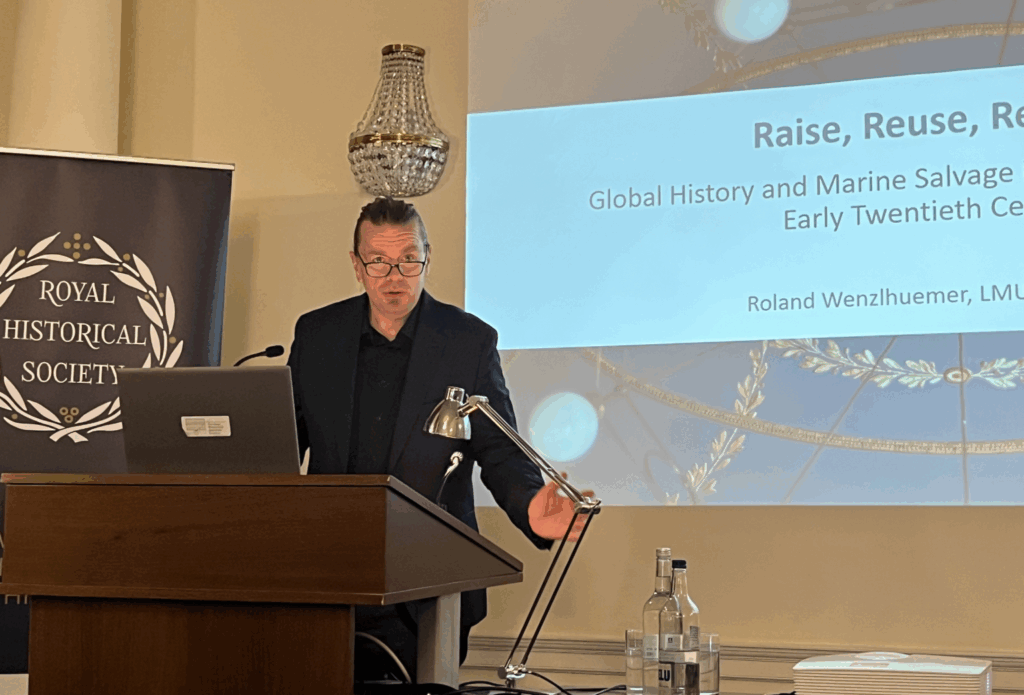
RHS / GHIL Global History Lecture 2025: ‘Raise, Reuse, Recycle: Global History and Marine Salvage in the Nineteenth and Early Twentieth Century’

About the event

Oceans and seas have long been a focal point in historiography, particularly in the field of global history, which emphasises the connective power of these vast bodies of water.

This focus naturally extends to the study of seafaring, shipbuilding, and maritime infrastructures. Yet while global history highlights oceanic linkages, it has also acknowledged the inherent dangers and uncertainties of seafaring, from the so-called Age of Exploration through to the twentieth century. Shipwrecks—ranging from minor groundings to catastrophic maritime disasters —have always played a central role in maritime history. Historians of this field have recognised the disruptive effects of these wrecks and have examined the development of maritime security and insurance systems designed to mitigate risks, safeguarding both passengers and investors alike.

But what of the wrecked ship itself, its lost cargo, and the tragic fate of its crew? What about the environmental or navigational hazards posed by these wrecks? And what of the symbolic weight that many sunken ships carry? This talk turns the spotlight on marine salvage and its significance in global history. Salvage operations, as ancient as seafaring itself, primarily aim to recover valuable resources or clear hazardous wreckage. At times, they also seek to uncover the causes of maritime accidents or to retrieve vessels of particular symbolic importance. Salvage work is a complex endeavour, fraught with nautical, technical, environmental, and legal challenges. Studying this practice offers valuable insights into the intricate dynamics of global connections and disconnections—insights this 2025 RHS / GHIL Global History Lecture aims to explore.

Speaker

Roland Wenzlhuemer is Professor for Modern History at the University of Munich and one of the directors of the Käte Hamburger Research Centre global dis:connect. His research focuses on global and colonial history. He has conducted studies on nineteenth-century colonial export economies, the history of global communication networks, and the history of shipping.

Listen to the lecture

An audio recording of ‘Raise, Reuse, Recycle: Global History and Marine Salvage in the Nineteenth and Early Twentieth Century’ is available here via the German Historical Institute, London’s podcast.


RHS President’s Address: ‘War and Peace: Mass Observation, Memory and the Ends of the Second World War in Britain’

About the event

Why does the Second World War continue to have such a hold over the popular imagination in early 21st century Britain? From Brexit to Covid, sporting competitions to environmental disasters, many public events are understood through reference to the Second World War and in particular the ‘signal events’ of 1940: Dunkirk, the Battle of Britain and the Blitz. Unlike the First World War, the memory of this second conflict is largely positive, focused on an imagined past in which people came together in adversity, overcoming the divisions of social class, political belief, and economics that had so divided 1930s Britain to defeat- against the odds – a powerful and ambitious enemy. In short, the Second World War is still widely remembered as Britain’s ‘finest hour’.

In this talk, Lucy Noakes will outline the history of this memory and argue that it has a particular resonance in times of turmoil and instability. Looking back at the ways Mass Observers were beginning to construct a memory of the war as it came to an end, in similarly uncertain times, this talk explores the ways in which people make use of the past in order to understand their presents.

Speaker:

Lucy Noakes is incoming President of the Royal Historical Society (November 20424) and Professor of History at the University of Essex. Her research focuses on social and cultural history of early to mid 20th century Britain, with a particular interest in the experiences and memories of those who experienced the First and Second World Wars.

Her most recent publication is entitled War and the British: Gender, Memory and National Identity 1939-1991. Revised Edition (Bloomsbury Academic, 2023). She is also the author of Dying for the Nation: Death, Grief and Bereavement in Second World War Britain (Manchester University Press, 2020), which won the Social History Society Book Prize in 2022, and an edited collection entitled Total War: An Emotional History (OUP, 2020), which considers ‘sentimentality’ and war memories.


Audio and video recordings of the panel event are now available.

Watch the event


Listen to the event