
The Royal Historical Society offers two annual PhD Fellowships for postgraduate historians in their third year of research at a university in the UK or overseas in order to complete a doctorate. The Fellowships comprise:
- Two RHS Centenary Fellowships: each Centenary Fellowship runs for 6-months and is worth £8,500 for final-year PhD students to complete their dissertations and to develop their research career.
All Fellowships are open to candidates without regard to nationality or academic affiliation. They are jointly held with the Institute of Historical Research (IHR), University of London, where Fellows are based.
Applications for the academic year 2026-27
Applications for the RHS PhD Fellowships for the academic year 2026-27 are now open (19 November 2025 to 31 January 2026).
Further information on the 2026-27 round of Fellowships, with details of how to submit an application are available from the Institute of Historical Research.
Centenary Fellows, 2025-26
 Angelina Andreeva is an RHS Centenary Fellow, 2025-26, held jointly with the Institute of Historical Research, University of London.
‘Mapping Lives: Ego Documents and Urban Experiences in London c. 1650-1690’
Angelina is a fourth-year PhD researcher at Lancaster University, supervised by Naomi Tadmor and Ian Gregory. Her doctoral work builds on her academic background in public history and linguistics, which she pursued in England, Italy, and Russia.
Her PhD project explores experiences of urban space in Restoration London, applying GIS mapping to personal diaries of Samuel Pepys, John Evelyn, and Robert Hooke. By recentering individual narratives, the project seeks to personalise the history of the period and open new perspectives on its urban environment.
The project’s innovative methodology augments traditional historical methods with digital humanities to shed light on a period of London’s history that has yet to be studied through this methodological lens. Treating personal diaries not only as historical texts but also as sources for spatial data, Angelina uses GIS mapping to visualise patterns and discrepancies, movements and perceptions across time and London’s city space. These methods have revealed distinct ways in which diarists navigated and understood their city, highlighting broader trends in Restoration London’s social geography.
By transforming complex historical data into accessible visual tools, Angelina aims to make her findings valuable not only to academics but also to non-specialist audiences, contributing to broader discussions around urban history, memory, and digital heritage.
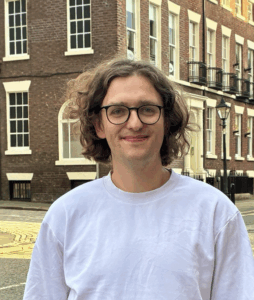 Joel Mead, is an RHS Centenary Fellow, 2025-26, held jointly with the Institute of Research, University of London.
Breaking and Remaking the British Egg: Intersections of Class, Health, Gender and Animal Welfare, 1941-1999
Joel is a PhD researcher in History at the University of Liverpool. He previously completed a BA in History at the University of Birmingham and an MA in Modern History at the University of Warwick.
His doctoral research investigates egg production and consumption in post-war Britain, exploring how the industrialisation of this staple food intersected with debates about health, identity, and the environment. Despite their cultural and political significance, eggs have received little scholarly attention compared to other foodstuffs.
Drawing on a wide range of sources—including government records, Mass Observation responses, advertisements, activist literature, and media representations—the project reconstructs the cultural and political life of eggs, showing how their meanings were produced and contested across institutions, households, and public discourse. In doing so, it illuminates wider histories of health, the environment, and modern British society and engages with debates on the intensification of agriculture, the changing British diet, and the moral politics of eating.
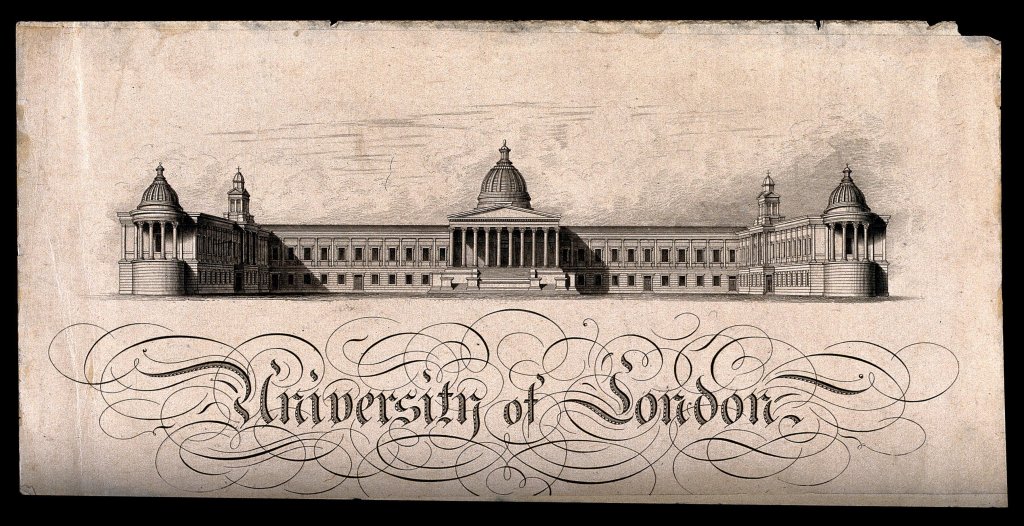
HEADER IMAGE: University College London: the main buildings seen from Gower Street. Engraving. Wellcome Collection, public domain